
Customer journey stages for service websites are five distinct phases that define how a potential client moves from first discovering your business to actively recommending it to others. The industry standard framework, recognized by Built In and Koji, names these phases as Awareness, Consideration, Decision, Retention, and Advocacy. Each stage carries different customer expectations, emotional states, and website requirements. Service businesses that map these phases correctly convert more visitors into paying clients and more clients into repeat customers.
1. What are the five customer journey stages for service websites?
The five core stages of the customer journey are the current industry standard for mapping how clients interact with service websites. Each stage represents a distinct mindset and set of needs.
- Awareness. The customer realizes they have a problem and starts searching for solutions. At this stage, your website needs to appear in local search results and immediately communicate what you do and who you serve. A plumber's site, for example, must load fast and state its service area within the first screen.
- Consideration. The customer compares options. They read reviews, scan service pages, and look for proof that you can solve their specific problem. Testimonials, project photos, and clear service descriptions carry the most weight here.
- Decision. The customer is ready to act. Friction kills conversions at this stage. A visible phone number, a quote request form, and a clear call to action are the difference between a booking and a bounce.
- Retention. The job is done, but the relationship is not. Follow-up emails, satisfaction checks, and easy rebooking options keep clients coming back. Most service websites ignore this stage entirely, which is a costly mistake.
- Advocacy. A satisfied client becomes a promoter. Review requests, referral prompts, and social proof tools activate this stage. Advocacy is the lowest-cost lead generation channel available to a service business.
Understanding these phases shapes every marketing and web design decision you make. A site built without this framework treats all visitors the same, which means it serves none of them well.
2. How to identify and categorize service website touchpoints

Effective touchpoint identification requires tracking specific customer actions, not just page visits. A customer "submitting a quote request" is a more useful data point than "visiting the contact page." That level of detail reveals where clients drop off and why.
Touchpoints across a service website fall into three categories:
- Digital touchpoints: Landing pages, contact forms, quote request buttons, Google Business Profile listings, and email follow-ups.
- Human touchpoints: Phone calls, on-site consultations, and any direct message exchange.
- Service delivery touchpoints: Payment confirmation, job completion notifications, and post-service follow-up messages.
Context shapes how each touchpoint performs. A mobile user searching for an emergency electrician at 9:00 PM has a completely different emotional state than a desktop user browsing renovation ideas on a Saturday morning. Your call-to-action buttons, response times, and page layouts need to account for that difference.
Pro Tip: Map your touchpoints by device type. Check whether your quote form works smoothly on a phone, because most service inquiries come from mobile users in high-urgency situations.
3. Best practices for customer journey mapping and pain point prioritization
Journey maps built with five layers per stage give you a clear picture of where your service website succeeds and where it loses clients. The five layers are: stage, touchpoint, action, emotion, and pain point. Filling in all five for each stage forces you to think from the client's perspective, not your own.
Gathering voice-of-customer data
AI-moderated voice interviews capture authentic emotional language that internal assumptions never surface. When a client says they felt "confused" after reading your services page, that word tells you more than any analytics dashboard. Use verbatim customer language in your journey map. Write "confused" and "relieved," not "low satisfaction" and "positive outcome."
Scoring and prioritizing pain points
Not every friction point deserves equal attention. Score each pain point using this formula:
Frequency x Severity x Revenue Impact
| Pain Point | Frequency | Severity | Revenue Impact | Score |
|---|---|---|---|---|
| Quote form not mobile-friendly | High | High | High | Critical |
| No follow-up after inquiry | High | Medium | High | High |
| Services page lacks pricing info | Medium | Medium | Medium | Medium |
| No testimonials on homepage | Medium | Low | Medium | Low |
Assign exactly one owner to each top-scoring pain point. Shared ownership means no ownership. When one person is accountable for fixing the mobile quote form, it gets fixed.
Pro Tip: Start your journey mapping with the initial inquiry path, not the entire customer lifecycle. Mapping the path from first search to first contact yields the fastest, most measurable improvements.
4. How to optimize transitions between journey stages
Customers experience their journey holistically, not as a series of isolated touchpoints. A client who receives a fast, professional response to their quote request and then waits three days for a follow-up email will remember the wait, not the speed. Every stage transition is an opportunity to build or break trust.
The most common failure points in stage transitions for service websites include:
- No automated confirmation after a form submission, leaving the client wondering if their inquiry was received.
- A gap between the Consideration and Decision stages where no social proof appears at the moment the client is ready to commit.
- Zero communication between job completion and the next potential booking, which collapses the Retention stage entirely.
Fragmented communication across channels is the single most common cause of lost conversions on service websites. A client who emails, then calls, then fills out a form expects you to know their history. Unifying your email, phone, and website inquiry channels into one system prevents the frustration of clients repeating themselves.
"Customers don't separate the message from the messenger. A slow reply on one channel undermines every other positive experience you've created. Unified communication is not a luxury for service businesses. It is the baseline expectation."
Identify your "moments of truth," the high-emotion interactions where a client decides to stay or leave. For a tradie, that moment is often the first phone call after a quote request. If it goes to voicemail with no callback, the client moves to the next result. Assign a clear owner to each moment of truth and set a response standard.
5. Comparing customer journey mapping techniques for service websites
Different mapping methods suit different business sizes and goals. Starting with focused, high-stakes paths like the initial inquiry or renewal process prevents the paralysis that comes from trying to map everything at once.
| Method | Best For | Strengths | Limitations |
|---|---|---|---|
| Sticky-note workshop | Small teams, quick audits | Fast, visual, low cost | Relies on internal assumptions |
| Voice-of-customer interviews | Businesses with existing clients | Authentic emotional data, high accuracy | Time-intensive to conduct |
| Analytics-driven mapping | Websites with significant traffic | Data-backed, identifies real drop-off points | Misses emotional context |
| AI-moderated interviews | Scaling feedback collection | Efficient, reduces interviewer bias | Requires setup and tooling |
A sticky-note workshop works well for a service business doing its first journey audit. It gets the team aligned quickly and surfaces obvious gaps. Voice-of-customer interviews are the next step once you need real client language to validate your assumptions. Analytics-driven mapping becomes valuable when you have enough traffic to spot statistically meaningful patterns.
The right method is the one you will actually complete. A simple map built in an afternoon beats a perfect map that never gets finished.
Key Takeaways
The most effective approach to customer journey stages on service websites is to map all five phases with specific touchpoints, score pain points by revenue impact, and assign clear ownership to every critical moment.
| Point | Details |
|---|---|
| Five stages structure everything | Awareness, Consideration, Decision, Retention, and Advocacy each require different website features and content. |
| Touchpoint granularity matters | Track specific actions like quote form submissions, not just page visits, to find real drop-off points. |
| Score pain points to prioritize | Use Frequency x Severity x Revenue Impact to focus on fixes that move the needle fastest. |
| Transitions determine trust | The gap between stages is where clients are lost. Automate confirmations and unify communication channels. |
| Start focused, then expand | Map the initial inquiry path first. It delivers the fastest, most measurable results for service businesses. |
What I've learned from watching service businesses ignore the middle stages
Most service businesses obsess over Awareness and Decision. They spend money on Google Ads to get found and put a phone number on the homepage to capture the click. That covers two of the five stages. The other three get nothing.
Retention and Advocacy are where the real return on investment lives. A client who books twice and refers one friend is worth three times a one-time client. Yet the average service website has no follow-up sequence, no review request, and no reason for a past client to return. That is not a marketing problem. It is a design problem.
The other thing I see consistently is journey maps built entirely from internal assumptions. A business owner maps what they think the client experiences. Then a voice-of-customer interview reveals that clients feel "ignored" after submitting a quote form because no confirmation email arrives. That one word, "ignored," changes the entire priority list.
Assign ownership to your moments of truth before you do anything else. Decide who is responsible for responding to every inquiry within a set time. Make that standard visible on your website. Clients notice, and it sets you apart from every competitor who treats inquiry response as an afterthought.
— Lachie
How Baylineweb builds websites around the full client journey
Baylineweb designs service websites for tradies and local businesses in Geelong with every stage of the client journey built in from the start.
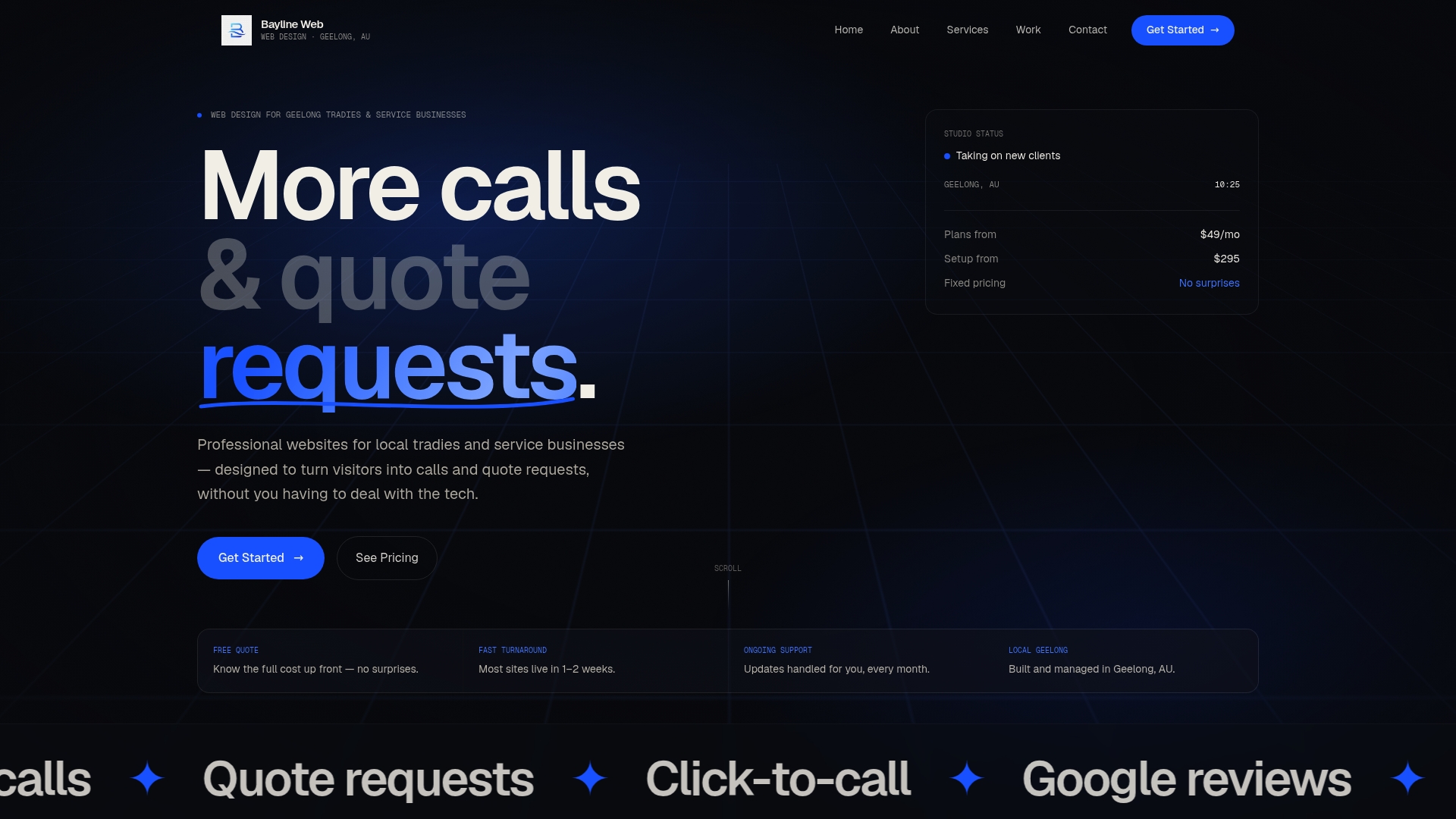
Every site includes click-to-call setup, quote request forms, and mobile-first layouts that reduce friction at the Decision stage. The web design work Baylineweb has completed shows how these features translate into real inquiries for real businesses. If you want a site that works across all five journey stages, not just the first two, the services and pricing page is the right place to start. Baylineweb works one-on-one with each client, which means the design reflects your specific service path, not a generic template.
FAQ
What are the five customer journey stages for service websites?
The five stages are Awareness, Consideration, Decision, Retention, and Advocacy. Each stage represents a distinct phase in how a potential client finds, evaluates, hires, and recommends a service business.
Why do service websites lose clients between the Consideration and Decision stages?
The most common cause is missing social proof at the moment a client is ready to commit. Testimonials, project photos, and a visible contact option must appear together on the same page to close that gap.
How do I prioritize which pain points to fix first on my service website?
Score each pain point by multiplying its frequency, severity, and revenue impact. Fix the highest-scoring issue first and assign one person to own that fix so it gets resolved.
What is a "moment of truth" in a customer journey?
A moment of truth is a high-emotion interaction where a client decides to stay or leave. For service businesses, the first response to a quote inquiry is the most common and most consequential moment of truth.
How often should I update my customer journey map?
Review your journey map whenever you change a core service, add a new channel, or notice a drop in inquiry conversions. A static map becomes inaccurate quickly as client behavior and website performance shift.